Monday, April 25, 2016

Agenda for 4/25

1. Bono: "The good news on poverty"

2. What is the state of global poverty for children?
  • 2.5 billion people lack access to improved sanitation.
  • 1 billion children are deprived of one or more services essential to survival and development.
  • 148 million children under the age of 5 in developing regions are underweight for their age.
  • 22 million infants are not protected from diseases by routine immunization.
  • In 2008, 8.8 million children worldwide died before their 5th birthday.
  • 4 million newborns worldwide are dying in the first month of life.
  • 2 million children under the age of 15 currently live with HIV.
  • 101 million children are not attending primary school.
  • Death by Birth Place: 7 countries are home to 65% of the world’s hungry: India, China, the Democratic Republic of the Congo, Bangladesh, Indonesia, Pakistan and Ethiopia.  
  • The number of people suffering from hunger is greater tha the population of the U.S., Canada and EU combined. 


4. What does the US Gov. spend per year on foreign aid, and how does this compare to the amount spent on the military per year?

  • $30 billion goes to programs that assist the world’s needy.
  • $663 billion goes toward military spending.


5. How does US spending on foreign aid compare to other wealthy countries?
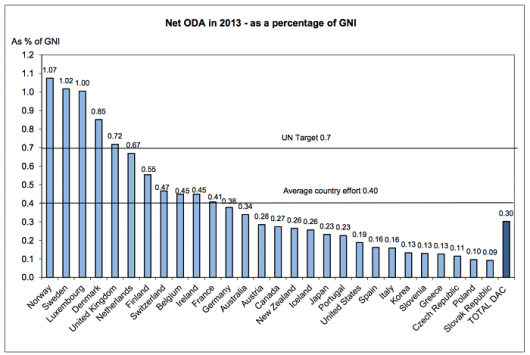
6. What does Bill Nye the Science Guy have to say about all of this?
  • What does the US spend on foreign aid? What is the myth?
  • What is the most common cause of death for Children 5 years old and younger?
  • Has foreign aid helped in Africa?

HW - Assignment #14

Answer the following questions: (quiz next class based on these questions - open notes)

1. Which 3 statistics about global poverty are the most significant to you? Explain why.
2. What percent of the federal budget, does the average American think the government spends on foreign aid each year?
3. Which types of projects receive the largest amounts of foreign aid spending?
4. What does the US Gov. spend per year on foreign aid? What percent of our country's annual spending is on foreign aid? 
5. How does the amount spent on foreign aid compare to the amount spent on the military per year
6. What is the most common cause of death for Children 5 years old and younger?
7. Cite a statistic that supports the fact that foreign aid has worked in Africa. 
8. Which challenge faced by people living on $1/day do you believe is most significant/pressing. With limited resources, which problem do you think should be addressed first? Water, employment, malnutrition, education, or natural disaster relief?


*Submit your answers to Assignment #14

Monday, April 11, 2016

Agenda for 4/12

1. Global Poverty "True-False" Quiz

2. Living On One - Change Series - view all episodes by clicking this link (to answer the questions below)

A. Answer the questions below as we watch each episode in the "Living On One - Change Series."

B. Click here for a brief summary of the important issues and essential questions covered in each episode.

C. Turn in your completed questions to eBackpack "Assignment #14 - Living on One Dollar Questions"

Ep. 1: The First Step

1. How many people live on less than $1 a day?

2. What would be the hardest thing to go without if you were forced to live on less than $1 a day?

3. Where do the filmmakers go to experience life on $1 per day.

4. Why do they want to study rural poverty?

5. What percent of Guatemalans live in poverty?

Ep. 2: Water from a Pipe?

6. How many people don't have access to fresh, clean water in their homes?

7. How many people per year die from water based illnesses?

8. How would water related diseases effect your life (even if it doesn't kill you)?

Episode 3: Hunger and Tortillas

9. What percentage of their daily calories were the apply to supply with their initial diet?

10. What is the difference between acute and chronic malnutrition?

11. What percent of Guatemalan children are malnourished?

12. What are the effects of malnutrition?

13. How can malnutrition lead to generational poverty?

14. How many people can be fed by the food produced in the world?

15. Then why do some still starve?

Ep. 4: Disaster Strikes

16. What is the difference between emergency aid and development aid?

17. What effects do natural disasters have on the poor.

18. What percent of the land do wealth land owners control?

19. What is the effect of the majority of the land being used for crash-crop agriculture?

20. What type of land is available to indigenous farmers? Why?

Ep. 5 – We need a Job

21. What do most people do for work in Pena Blanca?

22.  What is an informal job? What percent of Guatemalans have informal job? What about workers world-wide?

23. What are some of the problems faced by informal workers?

24. What are some of the problems faced by Victor as a farmer and day laborer?

25. What benefits come from a formal job?

Ep. 7: (Not) Going to School

26. What effect do language barriers have on native peoples in Guatemala? What percent know Spanish?

27.  Why are poor kids less likely to go to school even if school is free?

28. What percent of girls marry and start a family before 19?

Thursday, April 7, 2016

Agenda for 4/7

1. How the TSA working to prevent an airport attack in the US?

2. Peer Review Drone Paragraphs and/or turn in to eBackpack Assignment #13 - Drones Paragraph

3. Drone Debate - article

4. The Drone Debate

A. Review the three options

B. Choose your option

C. 10 mins to prepare

D. Debate!

HW - Find the answer:

How many people in the world live on $2 per day, or less?

Wednesday, April 6, 2016

Agenda for 4/6

1. Review Drones paragraph Grading Rubric and Checklist

2. Essential Paragraph Elements

  • Topic sentence - sentence at the beginning of the paragraph that states your opinion of drones
  • Document Evidence - from document packet, evidence to support your opinion
  • Specific facts - about drones, from the "History of Drones" article
  • Analysis - explain how each document supports your opinion
  • Summation - 1-2 sentences at the end of the paragraph to review the main point of the paragraph
3. Continue Work on Paragraphs and Peer Editing

HW - paragraphs are due next class (Friday 4/8)

Monday, April 4, 2016

Agenda for 4/4

1. Continue work on Drones DBQ Paragraph

  • review requirements for paragraph
  • review requirements for document and evidence use

2. See previous blog post for specific directions

3. Paragraphs are due Friday 4/8.

Wednesday, March 30, 2016

Agenda for 3/31

1. Drone Pilots. Whose behind the joystick? What are your thoughts about drone pilots?
2. Drones Persuasive Paragraph (test grade)

Your paragraph must answer one of these questions:

  • Should the US Gov. be able to kill an American citizen by drone strike without a trial?
  • Should the United States continue it's drone campaign against suspected terrorists?
3. Required Elements
    A. Topic sentence (paragraph thesis)
    • Clearly states your answer to the question and provides your overall reason for why you feel that way (answer + reason). 
      B. Evidence/Analysis
        • Specific Facts
          • Meets the standard - 6-8 specific facts from the History of Drones article to support your discussion of drone use by The United States.
          • Exceeds the standard 10 specific facts from the History of Drones article to support your discussion of drone use by The United States. 
        • Document Evidence
          • Meets the standard - 3 pieces of specific evidence from 3 different documents in the Drone document packet.
          • Exceeds the standard - 5 pieces of evidence in 5 different documents.
        • Analysis
          • For each piece of evidence from a document you must clearly ANALYZE (describe how/why) that document supports your answer to the question (which you stated in your topic sentence). Feel free to also include a SHORT quote directly from the document to back up your point. But keep quotes short. But be sure to clearly explain what the quote means in your own words, after the quote. And name the person or organization that you are quoting.
          • Meets the Standard - Provides analysis for each piece of document evidence.  
        • Transitions
          • There should be a clear transition that tells the reader you are moving on from one piece of the evidence to the next. Words and phrases like: additionally, furthermore, firstly, secondly, thirdly, in addition to, finally, another reason to support...etc. 
      C. Summation 
        • conclude your paragraph by restating (in different words) the claim made in your topic sentence (answer + reason)
      Persuasive Paragraph = Topic Sentence + Evidence/Analysis + Summation
        
      Sample:


      Persuasive Paragraph Check List 
      *Your paragraph also must be typed and proof read to fix errors in spelling, punctuation or grammar.

      Wednesday, March 23, 2016

      Agenda for 3/23

      1. The attack in Brussels

      2. Major attacks since the Paris attack in Nov.

      3. Assignment 12 - Terrorism Question


           A. How many total deaths from 9/11 attacks?

           Answer

           B. How many Americans have been killed (in the United States) by Radical Islamic terrorists    
           between 2002 and 2015?

           Answer

           C. How many terrorist attacks since 9/11 have been conducted by American citizens? How many
           have died as a result?

           Answer

           D. How many American soldiers have died in the Wars in Iraq and Afghanistan?

           Answer

           E. How many Iraqis and Afghanis have died as a result of the Wars in Iraq and Afghanistan?

           Violent deaths
           Total deaths

           F. How many people have died from terrorism world wide since 2001? Which countries are in the
           top 5 deadliest?

           Answer

           3. Share your opinion about the use of Drones to this padlet.


      4. Begin "Drone" (2014) - 

      DRONE is a documentary about the covert CIA drone war. Through voices on both sides of this new technology, DRONE reveals crucial information about the drone war in Pakistan and offers unique insights into the nature of drone warfare.

      Complete the "Drones: Pros and Cons" as we watch